
Background: Limitations of Traditional Games
As a studio specializing in large-scale open-world role-playing games (RPGs), we have long grappled with a persistent industry challenge: non-player character (NPC) interactions remain firmly rooted in script-driven systems. While NPCs can engage players through pre-written dialogue trees, they lack genuine memory and emotional continuity, making it impossible to form meaningful, evolving relationships over time.In conventional game architectures:
NPC dialogue relies on highly complex branching trees with limited dynamic generation and poor contextual coherence.
Player actions and choices are rarely retained or meaningfully reflected in long-term system behavior.
The game world feels lifeless, with NPCs functioning more like looped audio recordings than living inhabitants.
This results in shallow immersion, low replayability, and a noticeable “amnesia” problem—especially in narrative-heavy, high-agency RPGs where character development and player choices are central to the experience.
Introducing MemoryLake: Building a Game World with Memory
In early 2025, we partnered with Qizhuan Technology to integrate the MemoryLake multimodal memory platform into our next-generation game engine. Our goal was clear: give every NPC a persistent, evolving memory system that enables truly personalized, context-aware interactions.
Using MemoryLake, we created rich, memory-driven gameplay scenarios:
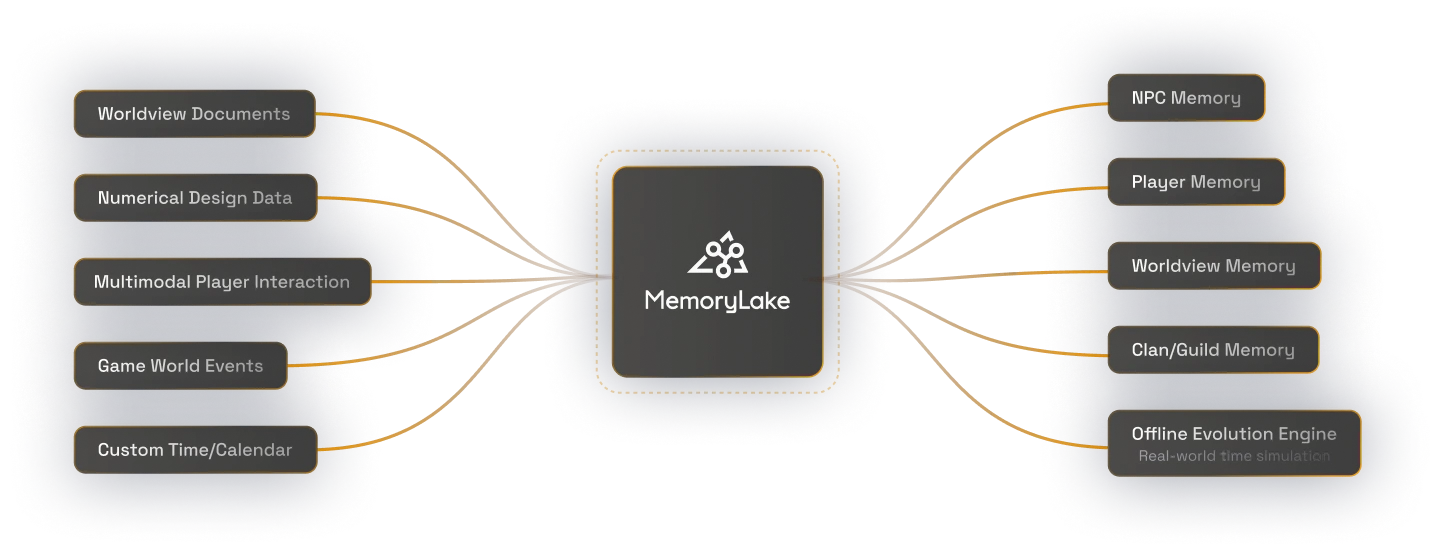
Dual-Track Memory System: World Lore + Player-Specific Memory
World Memory: NPCs retain global events, faction relationships, geographical changes, and other persistent world-state information, allowing the game’s history to evolve dynamically.
Player Memory: Each NPC independently remembers its unique history with the individual player—including dialogue, quest outcomes, behavioral patterns, and emotional responses.
Multi-Hop Reasoning and Dynamic Narrative Generation
MemoryLake’s memory engine enables NPCs not only to remember but also to reason. For example:If a player saved a village early in the game and returns months later (in real-world playtime), the same NPC might say:“Ah, [Player Name], hero of the Battle of the Northlands! I’ll never forget how you saved our village during that desperate fight. Word has it you’ve claimed a new sacred sword—seems the world owes you another debt.”This line is not pre-scripted. It is generated in real time based on the following memory chain:
Player identity recognition → Retrieval of “player-village rescue” memory → Association with “player recently acquired sacred sword” event → Integration with NPC personality (grateful disposition) → Coherent, emotionally appropriate response.
Equipment and State Memory Integration
NPCs remember changes in the player’s gear, skill progression, and faction reputation, reflecting these dynamically in dialogue and behavior. A legendary weapon might elicit awe or trigger special quests; betraying a faction could result in suspicion or hostility from associated NPCs in future encounters.
Emotional Memory Modeling
NPCs develop evolving emotional states (trust, suspicion, gratitude, etc.) based on accumulated memories, which influence their actions and tone.
Three Core Challenges in Building an Open-World Memory System
Developing a robust memory system for open-world games presented three major technical hurdles:
Massive Scale of Memory Storage
Hundreds of NPCs and thousands of concurrent players each require dedicated memory spaces, leading to exponential growth in total memory volume. Retrieval must occur in sub-second time to preserve smooth, real-time interaction.
High Complexity of Memory Management
Memories must be dynamically created, updated, merged, and forgotten. The system needs intelligent compression, noise filtering, complex inter-memory associations, multi-hop reasoning, and timeline navigation while preserving logical consistency.
Game-Specific Memory Requirements
Long temporal spans: In-game time can span years, requiring time-aware · evolution of memories.
Vast spatial scale: Memories must support spatial associations across maps, factions, and events.
Novel world understanding: The system must internalize the game’s unique lore, rules, and social structures.
Building a Scalable, Manageable, and Evolvable Game Memory Core
MemoryLake addressed these challenges through several key capabilities:
Ultra-Large-Scale Memory Storage: Extreme Cost-Efficiency and Performance
Multimodal storage engine supporting vector embeddings, knowledge graphs, JSON-structured data, and full PostgreSQL compatibility, with distributed architecture capable of millisecond retrieval across tens of millions of memory entries.
Serverless elastic scaling automatically adjusts storage and compute resources to memory volume, eliminating manual operations and significantly reducing operational costs.
Proven high-concurrency, low-latency performance: In production environments, MemoryLake has handled over 10 trillion records while maintaining sub-second response times—fully meeting the demands of large-scale multiplayer online games.
Human-Like Memory Management: Giving NPCs a Real “Mind”
MemoryLake’s core engine simulates human memory mechanisms:
Memory Organization: Concept association networks, multi-layered dynamic knowledge graphs, and semantic clustering create natural connections between memories, enabling complex multi-hop reasoning (e.g., linking “player saved village” → “player acquired sacred sword” → “player may become kingdom hero”).
Memory Evolution & Forgetting: Built-in timeline tracking and evolution mechanisms allow memories to develop naturally over time. Intelligent conflict resolution merges contradictory entries; Ebbinghaus-inspired forgetting curves automatically prioritize high-value memories and filter noise, keeping the memory base efficient and relevant.
Memory Retrieval: Sub-second multi-hop and cross-concept queries with role-, faction-, and quest-based access controls. Outputs structured, concise memory summaries (instead of raw logs), reducing token consumption by an average of over 50% and dramatically improving inference efficiency.
From “One Face for All” to “A Thousand Faces for a Thousand Players”
After integrating MemoryLake, player feedback during testing showed dramatic improvements:
Significantly Enhanced Immersion
Players felt genuinely “remembered.” NPCs proactively referenced past interactions and used memories to suggest follow-up quests, creating continuous emotional bonds.
Greater Narrative Agency and Replay Value
Player choices are permanently recorded and shape future storylines. The same quest can unfold into dozens of distinct dialogue paths and endings based on individual player history.
Improved Operational Efficiency and Content Generation
Dynamic dialogue generation replaces manual authoring of massive branching scripts, while ensuring narrative coherence. Memory data analytics reveal player behavior patterns to inform future updates and DLC design.
We now consider MemoryLake core infrastructure for next-generation game AI. Future plans include:
Cross-NPC memory sharing via “rumor propagation” to create realistic social networks.
Secure player memory export (anonymized) for generating personalized story recaps, highlight reels, and community features.
Memory: The Soul of Intelligent Games
With MemoryLake, we have shifted from script-driven to memory-driven game design. NPCs are no longer repetitive recordings but persistent, living virtual beings. This represents both a technical leap and a fundamental evolution in narrative and interaction philosophy.As DataCloud Technology states: “The future of AI is memory-driven.” For us, the future of games is equally memory-driven. MemoryLake has not only delivered smarter NPCs—it has opened the door to truly alive virtual worlds.